Speaking the Same Visual Language: How Studios Decode the Aesthetics Clients Can't Quite Name
Speaking the Same Visual Language: How Studios Decode the Aesthetics Clients Can't Quite Name
Every client arrives with a feeling. It might arrive as a Pinterest board dense with contradictions — a moody Scandinavian interior beside a sun-drenched California campaign, a 1970s Italian film still beside a contemporary Brooklyn editorial. It might arrive as a single adjective: cinematic, elevated, gritty, warm. It might arrive as a reference to a brand the client admires but insists they do not want to imitate. Whatever its form, that feeling is the seed of the entire project. The studio's first and perhaps most critical task is not to begin producing — it is to listen, decode, and construct a shared language precise enough to guide every decision that follows.
This translation process is rarely discussed in public-facing conversations about creative work. Clients see the finished deliverable. They do not see the weeks of alignment work that made it possible. At Studio P9, that alignment is not incidental to the process — it is the process.
Why Abstract References Are Actually Useful
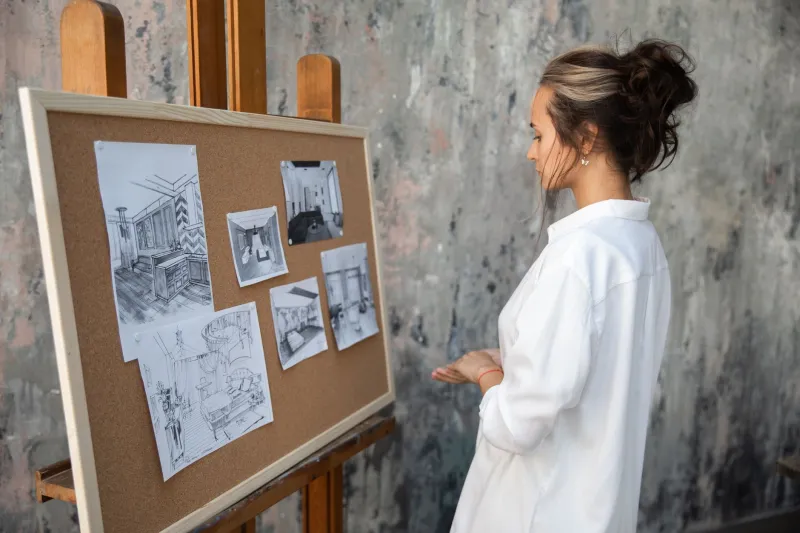
It might seem that vague references complicate a project. In practice, they often reveal more than a highly specific brief. When a client shares a mood board assembled without editorial intention — images pulled instinctively, without overthinking — they are surfacing genuine aesthetic preferences that no written brief could fully articulate. The role of the studio is to read that board not as a list of things to reproduce, but as a map of emotional territory.
A skilled creative director will look at a collection of seemingly disparate references and ask: what is the quality these images share? Is it the quality of light — diffused, directional, high-contrast? Is it a color temperature — cool and desaturated, or amber and organic? Is it a compositional logic — centered and symmetrical, or asymmetrical and kinetic? These questions move the conversation from what things look like to how things feel, which is the register in which all meaningful creative decisions are ultimately made.
Adjectives like cinematic or raw are not problems to be dismissed. They are invitations. Cinematic might mean anamorphic lens flare and shallow depth of field, or it might mean deliberate pacing and restrained color grading — and only a structured conversation will reveal which. The studio's job is to ask the follow-up questions that clients rarely know to ask themselves.
Building a Shared Creative Vocabulary
Once a studio has gathered its references and conducted its initial discovery conversations, the real construction work begins: assembling a creative framework specific enough to function as a production guide, yet flexible enough to allow for the kind of in-the-moment decisions that distinguish craft from execution.
The most effective tool in this process is the visual brief — distinct from the written brief a client might provide. A visual brief synthesizes references, defines a tonal range, and establishes the visual rules that will govern the project. It answers questions the production team will face constantly: What is the light quality in this world? What is the relationship between foreground and background? What palette governs this brand expression? What typefaces, if any, carry the right cultural weight?
At the more granular level, studios often build style frames — static composites that demonstrate the intended visual language before any full production begins. A style frame is not a storyboard panel; it is a proof of concept for aesthetic direction. It answers the question does this feel right? in a low-stakes environment, where adjustments cost hours rather than days.
Another underutilized tool is the reference annotation session — a structured conversation in which the studio and client review references together, with the studio verbalizing what it reads in each image. This process frequently surfaces misalignments early. A client may have included a reference because they love its subject matter while the studio has interpreted it as an aesthetic reference. Catching that distinction before production begins is invaluable.
The Vocabulary Becomes the Project
What happens when this shared language is built carefully? It becomes the invisible architecture of the entire production. Cinematographers make lighting decisions that honor it. Editors make pacing decisions that serve it. Motion designers choose easing curves that feel consistent with it. The result is a coherent body of work that feels intentional from every angle — not because every contributor was following rigid instructions, but because every contributor understood the emotional register they were working within.
This coherence is what separates a project that looks assembled from one that feels authored. Audiences and viewers rarely articulate why one piece of content feels more trustworthy or more compelling than another. But the difference is almost always traceable to whether the creative team was operating from a shared visual vocabulary or improvising in the absence of one.
What This Means for Business Owners and Aspiring Creatives
For business owners preparing to engage a production partner, the most valuable investment you can make before the first meeting is not a polished brief — it is a considered collection of references, accompanied by honest notes about why each one resonates. You do not need to know the technical language. You need to know how something makes you feel, and to be willing to explore that feeling in conversation.
For aspiring creatives entering studio environments, learning to read a mood board analytically — to identify the underlying aesthetic logic rather than cataloging surface details — is one of the most transferable skills in the profession. It applies equally to photography, motion, graphic design, and brand strategy.
The mood board is not the destination. It is the first sentence of a conversation that, when conducted with rigor and genuine curiosity, leads to work neither party could have defined alone. That conversation — structured, iterative, and grounded in craft — is where the real production begins.